T-Shirt Shape Visualizer
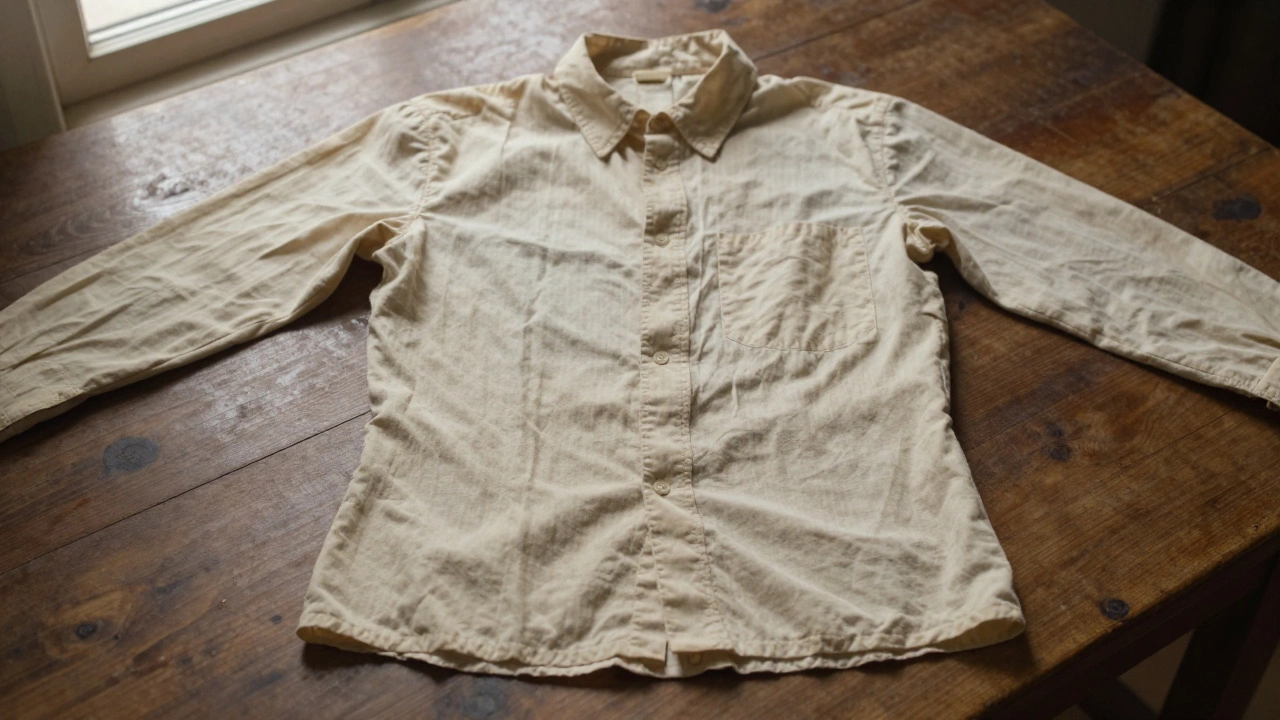
The "T" in T-shirt refers to the garment's shape when laid flat. This tool demonstrates how different T-shirt styles maintain the basic T shape.
How the T-shape works
The vertical line is the body, and the horizontal lines are the sleeves. When laid flat, all T-shirts maintain this T shape - even with variations in fit or sleeve length.
Ever looked at your favorite T-shirt and wondered why it’s called a T-shirt? It’s not because it’s shaped like the letter T - at least, not exactly. The truth is simpler, older, and a lot more practical than you might think.
The T in T-shirt isn’t about style - it’s about shape
The "T" in T-shirt refers to the basic outline of the garment when laid flat. The body forms the vertical line, and the sleeves form the horizontal crossbar. When you spread it out on a table, it looks like the letter T. That’s it. No hidden meaning. No branding trick. Just a straightforward description of its structure.
This naming convention started in the late 19th century, when undershirts made from lightweight cotton became popular among laborers and soldiers. These shirts were designed to be simple, breathable, and easy to mass-produce. Manufacturers didn’t need fancy names - they just needed to tell workers and retailers what they were selling. Calling it a "T-shirt" was clear, visual, and efficient.
Before T-shirts were fashion, they were workwear
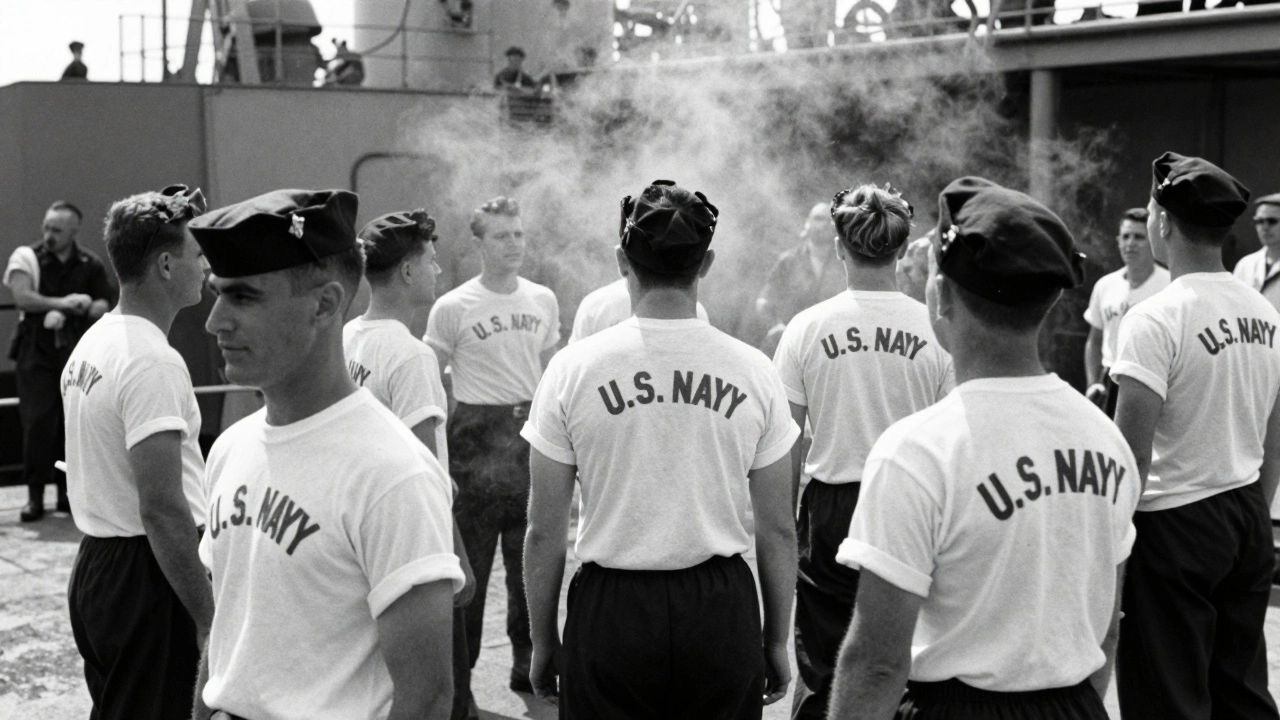
In the 1890s, American sailors and dockworkers started wearing short-sleeved cotton undershirts under their uniforms. These weren’t meant to be seen. They were functional - absorbing sweat, reducing friction from heavier outer layers, and staying cool in hot conditions. The U.S. Navy officially adopted them in 1913 as standard issue underwear.
By World War II, the T-shirt had become standard issue for U.S. troops. Soldiers wore them under uniforms, and sometimes alone when off-duty. After the war, returning veterans brought them home. They were cheap, comfortable, and already familiar. That’s when the T-shirt began its slow journey from underwear to outerwear.
Pop culture turned the T-shirt into a statement
It wasn’t until the 1950s that the T-shirt broke free from its utilitarian roots. Marlon Brando wore one in A Streetcar Named Desire (1951), and James Dean followed in Rebel Without a Cause (1955). Suddenly, the T-shirt wasn’t just clothing - it was rebellion. It was youth. It was attitude.
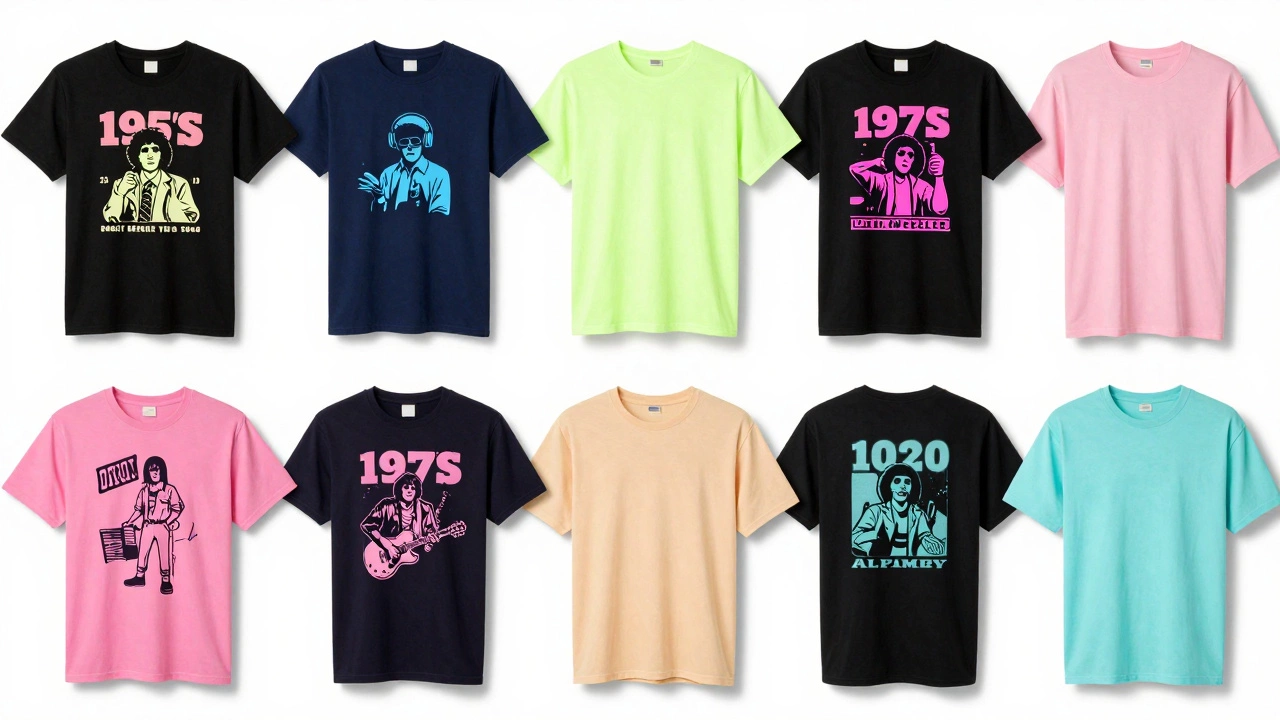
By the 1960s and 70s, screen printing made it easy to put logos, slogans, and artwork on T-shirts. Music bands, political movements, and advertising campaigns all jumped on the trend. The T-shirt became a canvas. The "T" didn’t change, but what it represented did. It went from a shape to a symbol.
Why not call it something else? Like "cotton shirt" or "short-sleeve"?
Good question. Many other garments are named after their shape or cut - think "sweater," "pullover," or "tank top." But "T-shirt" stuck because it was unique. There wasn’t another common garment that looked like a T. And once it became a cultural staple, the name locked in.
Other names were tried. In the 1930s, some retailers called them "A-shirts" (for "athletic shirt") or "undershirts." But those didn’t catch on. "T-shirt" was too simple, too visual. Even people who didn’t know the history could picture it.
Modern T-shirts still follow the same design
Today, you can buy T-shirts in every color, fabric, and fit imaginable - cropped, oversized, fitted, ribbed, performance-blend, organic cotton, you name it. But the core shape? Still a T. The sleeves are wider now. The necklines vary. Some have raglan sleeves or dropped shoulders. But if you lay one flat, it still forms that unmistakable T.
Even high-end fashion brands like Balenciaga or Uniqlo’s premium lines stick to the same basic structure. Why? Because it works. It’s comfortable. It’s easy to move in. And it’s instantly recognizable. The T isn’t just a letter - it’s a design language that’s lasted over 100 years.
What about other shirt names? Do they follow the same logic?
Yes. Many clothing items are named after their shape or construction:
- Tank top: Named because early versions resembled the straps of a swimming tank (or water tank) - no sleeves, just straps.
- Polo shirt: Originally worn by polo players, with a collar and buttoned placket.
- Henley shirt: Has a collarless, buttoned placket - named after the English town of Henley where rowers wore them.
- Button-down shirt: The collar buttons to the shirt body, originally designed to keep it from flapping during horseback riding.
So the T-shirt isn’t an outlier. It’s part of a long tradition of naming clothes based on form, function, or origin. The T-shirt just happened to be the one that became global.
Is there any chance the "T" stood for something else?
People love to invent stories. You’ve probably heard that "T" stands for "tee-shirt" (as in "tee" the golf club), or "tactical," or even "team." None of those are true. The earliest documented use of "T-shirt" appears in a 1920s catalog from the U.S. Army Supply Corps. It’s listed as "T-shirt" with no explanation - implying the term was already common.
The Oxford English Dictionary traces the term back to 1920. There’s no evidence of any alternative meaning. The shape explanation is the only one supported by historical records, fashion archives, and manufacturing documents.
So what’s the takeaway?
The "T" in T-shirt stands for the shape of the garment. No mystery. No marketing spin. Just good, old-fashioned practicality. It’s a reminder that some of the most enduring things in life aren’t complicated - they’re simple, functional, and well-designed.
Next time you pull on a T-shirt, remember: you’re wearing a piece of history that’s been shaped by sailors, soldiers, rebels, and artists. And it still looks like a T - because sometimes, the simplest solutions last the longest.
Is the T in T-shirt short for "tee" as in golf?
No. The "T" doesn’t stand for the golf club. That’s a common myth. The name comes from the shape of the shirt when laid flat - resembling the letter T. The term was in use by the 1920s, long before golf apparel became popular.
Why do some people call it a "tee"?
"Tee" is just a casual, shortened version of "T-shirt." It’s slang, not an official term. You’ll hear it in conversations, ads, and stores - but it’s not the original name. The full term "T-shirt" is still the correct and most widely accepted form.
Do all T-shirts have the same shape?
Most do, yes. Even modern variations like cropped, oversized, or fitted T-shirts still follow the basic T structure: a vertical body with two horizontal sleeves. If it doesn’t form that shape when laid flat, it’s not technically a T-shirt - it might be a tank top, a raglan, or another style.
Was the T-shirt always worn as outerwear?
No. For decades, it was strictly underwear. Soldiers and laborers wore it under uniforms or other shirts. It didn’t become acceptable as outerwear until the 1950s, when Hollywood stars like Marlon Brando and James Dean wore them on screen - making them symbols of rebellion and youth culture.
Can a T-shirt have long sleeves and still be called a T-shirt?
Yes. The "T" refers to the overall silhouette, not the sleeve length. A long-sleeve T-shirt still has the same body shape - vertical torso with horizontal sleeves. The only difference is the length of the sleeves. You’ll see them called "long-sleeve T-shirts" in stores, and they’re still T-shirts.