If you work in construction, manufacturing, warehousing, or any job where heavy objects, sharp tools, or slippery floors are part of the day, your feet need more than just comfort-they need protection. That’s where OSHA approved footwear comes in. But what does that label actually mean? And how do you know if the boots you’re buying are truly safe for your job?
What OSHA Approved Footwear Really Means
OSHA stands for the Occupational Safety and Health Administration. It’s the U.S. government agency that sets and enforces workplace safety rules. OSHA doesn’t directly approve shoes. Instead, it says employers must provide protective footwear when there’s a risk of foot injuries-and that footwear must meet standards set by another group: ASTM International.
So when someone says "OSHA approved footwear," they really mean "footwear that meets ASTM standards and satisfies OSHA’s requirement for protection." It’s a common shortcut, but technically, OSHA approves the workplace safety program, not the shoe itself.
OSHA’s rule, 29 CFR 1910.136, says employers must ensure employees wear protective footwear when there’s a danger of foot injuries from falling or rolling objects, objects piercing the sole, or electrical hazards. That’s it. The actual safety specs? That’s ASTM’s job.
The ASTM Standards Behind the Boots
The real test for safety footwear comes from ASTM F2413, the standard for protective footwear. This standard breaks down what kind of protection a shoe must offer-and how to test it.
Here’s what you’ll see on a proper pair of work boots:
- Impact Resistance (I): The toe area can handle a 75-pound weight dropped from 18 inches. Look for "I/75" on the label.
- Compression Resistance (C): The toe can handle up to 2,500 pounds of compression. Marked as "C/75".
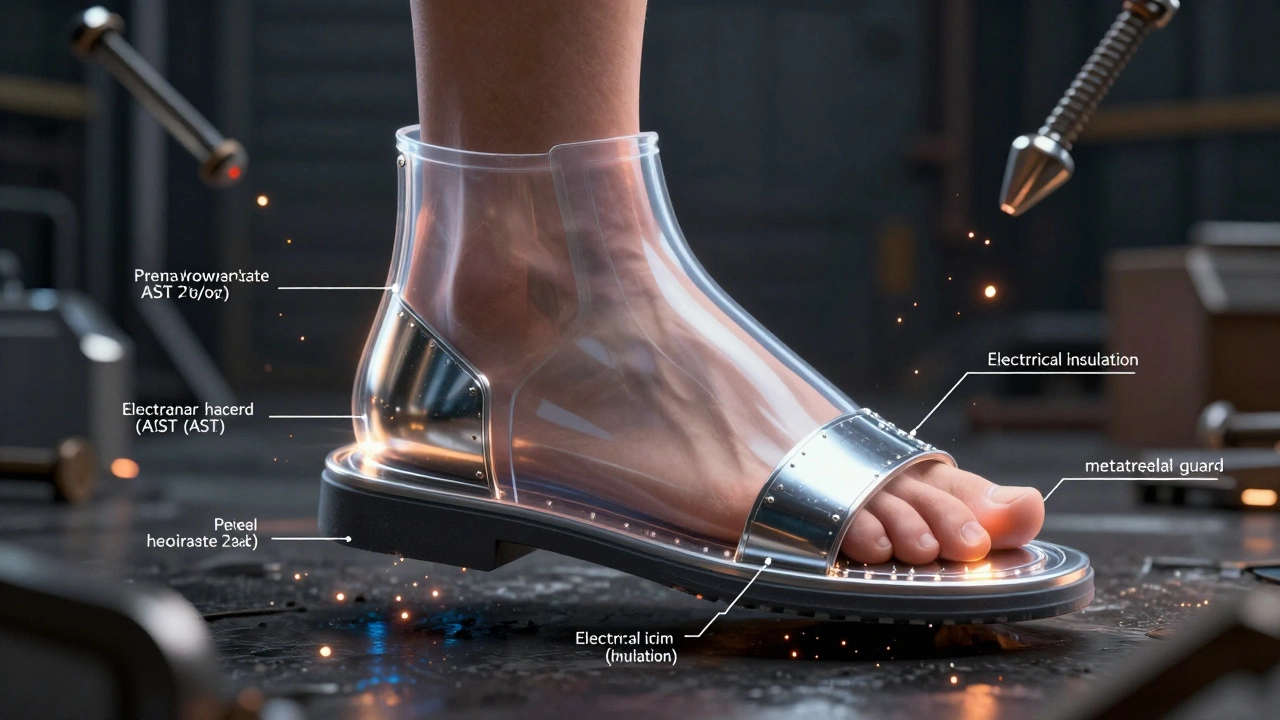
- Metatarsal Protection (Mt): A shield over the top of the foot to guard against crushing. Often built into the boot or added as an external guard.
- Electrical Hazard Protection (EH): Soles are designed to reduce the risk of electric shock from live circuits. Tested at 18,000 volts under dry conditions.
- Static Dissipative (SD): Helps prevent static buildup in environments where sparks could ignite flammable materials.
- Puncture Resistance (PR): A plate in the sole stops sharp objects like nails from piercing through.
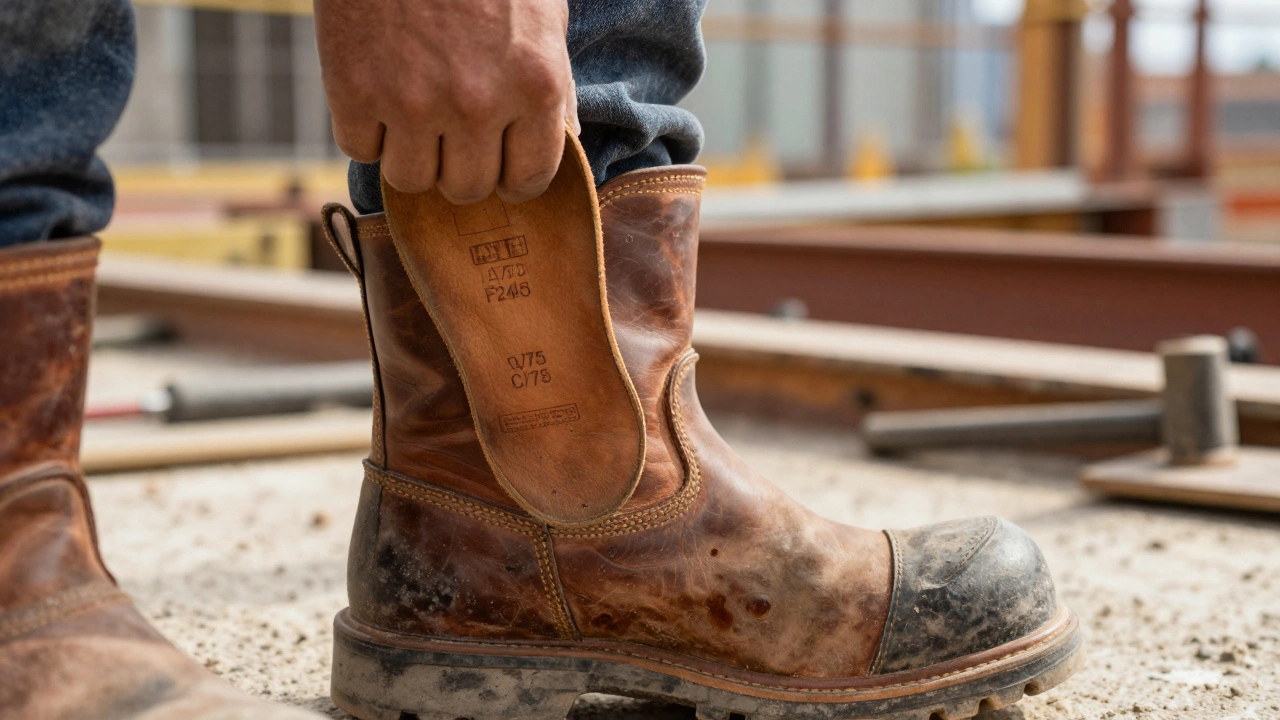
These ratings are printed on the shoe’s label or stamped inside. If you don’t see any of these codes, it’s not safety footwear-even if it looks tough.
Common Misconceptions About Safety Boots
Many people think steel toes are the only kind of protection that matters. That’s not true. While steel toes are common, composite toes made from materials like fiberglass or Kevlar are just as strong-and lighter and non-metallic, which is important if you work near metal detectors or in cold environments.
Another myth: All work boots are safety boots. Not even close. A regular hiking boot or steel-toe fashion boot without ASTM markings doesn’t meet OSHA requirements. Just because it has a reinforced toe doesn’t mean it passed the impact or compression tests.
And what about waterproofing or insulation? Those are comfort features, not safety features. A boot can be waterproof, warm, and stylish-but still fail OSHA if it lacks impact or puncture protection.
How to Spot Real OSHA-Compliant Footwear
Here’s how to check if a pair of boots actually qualifies:
- Look for the ASTM F2413 label inside the shoe. It’s usually on a tag or stamped on the insole.
- Check for the specific protection codes: I/75, C/75, EH, PR, etc.
- Make sure the manufacturer’s name and model are clearly listed.
- Verify the shoe is marked as meeting ASTM F2413-no other standard counts.
- If you’re buying online, the product description must list ASTM F2413 compliance. If it doesn’t, assume it’s not approved.
Don’t trust marketing terms like "industrial-grade," "heavy-duty," or "safety toe" unless they’re backed by the ASTM code. Those are buzzwords. The ASTM code is the law.
Who Needs This Footwear?
You don’t need OSHA-approved footwear just because you want to feel safer. You need it if your job puts your feet at risk. Common examples:
- Construction workers (falling tools, rebar, concrete blocks)
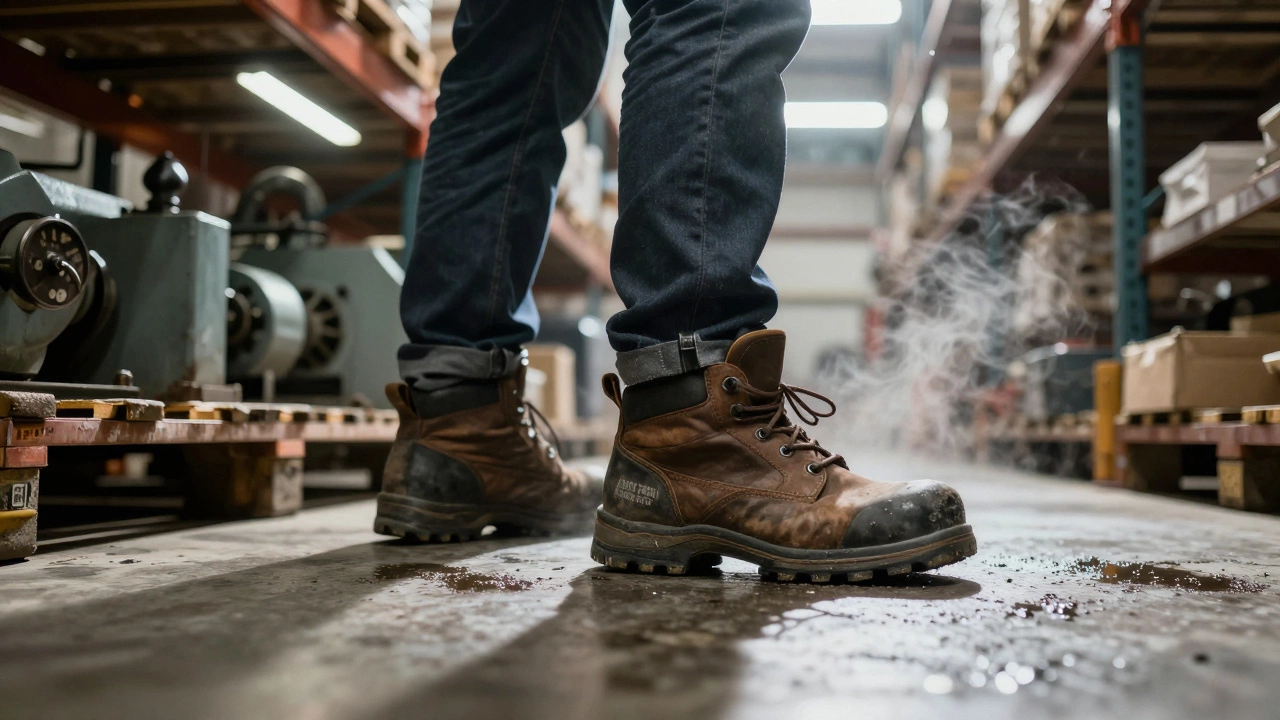
- Warehouse staff (pallets, boxes, forklift traffic)
- Factory line workers (machinery, hot surfaces, sharp edges)
- Electricians (risk of live wires)
- Loggers and forestry workers (sharp branches, heavy logs)
- Garbage collectors (need puncture-resistant soles for syringes, glass, nails)
Even if your employer doesn’t require it, wearing proper safety footwear reduces your chance of a serious injury by over 60%, according to OSHA data. That’s not just compliance-it’s common sense.
What Happens If You Don’t Wear It?
OSHA can fine employers up to $15,625 per violation for not providing or enforcing safety footwear. But the bigger risk is you.
Every year in the U.S., over 15,000 workers suffer foot injuries on the job. About 2,000 of those require time off. Many result in permanent damage. A single dropped tool can crush toes, break bones, or even require amputation. Puncture wounds from nails or metal scraps can lead to infections that spread fast.
Wearing the right footwear doesn’t just keep you compliant. It keeps you working.
How to Choose the Right Pair
Not all safety boots are the same. Your job determines your needs:
- For heavy lifting? Go for I/75 and C/75-rated steel or composite toes.
- Working with electricity? Look for EH-rated soles.
- Dealing with sharp debris? Make sure it has PR (puncture resistance).
- Working in wet or oily areas? Choose slip-resistant outsoles marked with ASTM F2913.
- On your feet all day? Look for cushioned insoles and ankle support. Comfort matters-because if the boots hurt, you won’t wear them.
Try them on at the end of the day when your feet are swollen. Wear the same socks you’ll wear on the job. Walk around the store. Make sure there’s no pinching, no rubbing, and enough room for your toes to wiggle.
Who Pays for It?
OSHA requires employers to pay for required safety footwear if it’s used only at work. That means if your job demands steel-toe boots and you can’t wear them outside of work, your employer must cover the cost.
But if you can wear the boots outside work (like a general-purpose safety boot), the employer may ask you to pay for them. That’s legal-but only if they’re not exclusive to your job duties.
Always ask your supervisor or safety officer. If they say you need them and you’re paying out of pocket, push back. You have rights.
Replacing Your Boots
Safety footwear doesn’t last forever. Even the best pair wears out.
Replace them if:
- The toe cap is dented or cracked
- The sole is worn thin or separating
- The insole has lost its cushion
- You’ve had them for more than 6-12 months of daily use
Don’t wait until they fall apart. A damaged safety boot is worse than no boot at all-it gives you a false sense of security.
Final Thoughts
OSHA approved footwear isn’t about looking tough. It’s about coming home with all your toes intact. It’s not optional if your job has hazards. And it’s not a fashion statement-it’s a piece of safety equipment, like a hard hat or gloves.
Buy the right pair. Check the ASTM label. Wear them every shift. And if your employer won’t provide them, know your rights. Your feet carry you through your workday. Make sure they’re protected.
Are steel-toe boots always OSHA approved?
No. Steel-toe boots are only OSHA approved if they meet ASTM F2413 standards. Many steel-toe boots on the market are for fashion or light use and don’t pass impact or compression tests. Always check for the ASTM code inside the boot.
Can I use hiking boots as safety footwear?
No. Hiking boots are designed for trail traction and ankle support, not workplace hazards. Unless they’re specifically tested and labeled as ASTM F2413 compliant, they won’t meet OSHA requirements-even if they have a reinforced toe.
Do I need OSHA-approved shoes if I work in an office?
Generally, no. If your job doesn’t involve falling objects, sharp tools, electrical hazards, or heavy machinery, OSHA doesn’t require safety footwear. But if you occasionally enter a warehouse or construction zone, your employer may require it during those visits.
Is composite toe better than steel toe?
It depends. Composite toes are lighter and won’t set off metal detectors, making them better for airport workers or those in cold environments. Steel toes offer slightly more protection in extreme impacts. Both are equally approved if they meet ASTM F2413 standards.
Can I wear OSHA-approved footwear outside work?
Yes, if your employer allows it. OSHA doesn’t restrict where you wear approved footwear. Many workers wear their safety boots daily because they’re durable and comfortable. But if your employer requires you to pay for them, they must allow you to use them outside work unless they’re job-specific.